Does tirzepatide work mainly because digestive symptoms make eating unpleasant? A 2025 analysis of the SURMOUNT-1 through SURMOUNT-4 trials examined that question by comparing weight change among participants who did and did not report particular gastrointestinal symptoms. Substantial weight reduction occurred in both groups. Statistical modeling also suggested that the measured symptoms accounted for only a small share of the estimated treatment effect.
That finding needs precise boundaries. Participants were randomly assigned to tirzepatide or placebo, not to experience nausea. Most analyses kept the four trials separate, and weight measurements after treatment discontinuation were excluded. This article examines the full primary post hoc report and its main table, together with selected current official label sections; supplementary tables and original trial protocols were not independently reviewed. The evidence challenges the idea that feeling sick is necessary for weight loss without making digestive symptoms harmless or explaining tirzepatide’s receptor-specific biology.
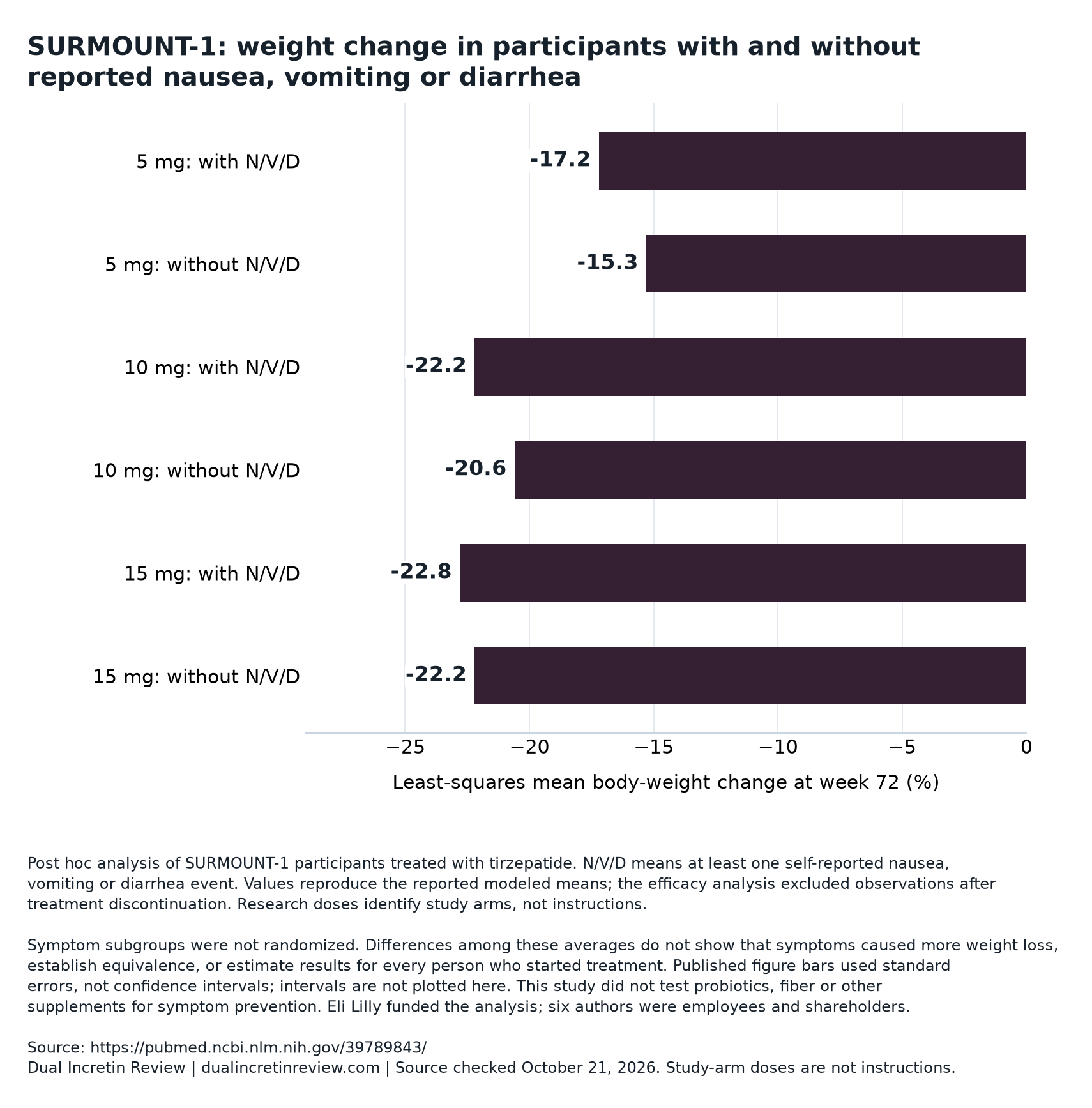
SURMOUNT-1: weight change in participants with and without reported nausea, vomiting or diarrhea
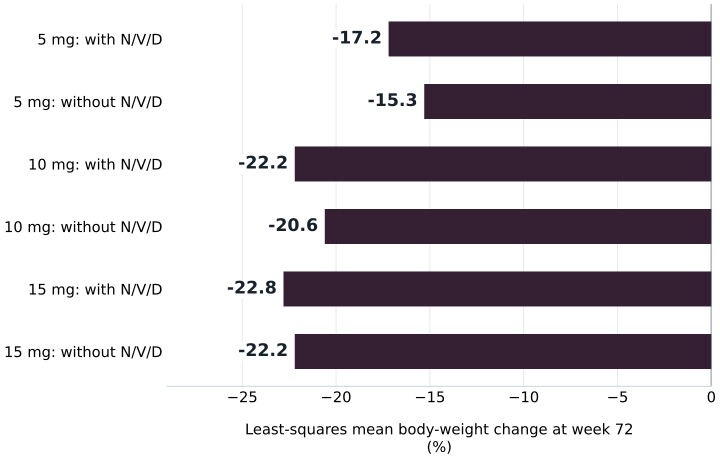
Post hoc analysis of SURMOUNT-1 participants treated with tirzepatide. N/V/D means at least one self-reported nausea, vomiting or diarrhea event. Values reproduce the reported modeled means; the efficacy analysis excluded observations after treatment discontinuation. Research doses identify study arms, not instructions.
Symptom subgroups were not randomized. Differences among these averages do not show that symptoms caused more weight loss, establish equivalence, or estimate results for every person who started treatment. Published figure bars used standard errors, not confidence intervals; intervals are not plotted here. This study did not test probiotics, fiber or other supplements for symptom prevention. Eli Lilly funded the analysis; six authors were employees and shareholders.
Source 1Download the source-labeled chart (PNG) · Download the data (CSV)
| Randomized dose and nonrandomized symptom subgroup | Reported value |
|---|---|
| 5 mg: with N/V/D | -17.2 |
| 5 mg: without N/V/D | -15.3 |
| 10 mg: with N/V/D | -22.2 |
| 10 mg: without N/V/D | -20.6 |
| 15 mg: with N/V/D | -22.8 |
| 15 mg: without N/V/D | -22.2 |
Sections in this article
A dual-receptor drug, but not a receptor experiment
Tirzepatide activates receptors for two incretin hormones: glucose-dependent insulinotropic polypeptide, or GIP, and glucagon-like peptide-1, or GLP-1. That makes it a dual-receptor agonist—a drug that activates two receptor types. It does not mean participants received two separate drugs. The distinction is explained further in what dual incretin means. Here, investigators studied once-weekly subcutaneous tirzepatide, meaning injection under the skin, against placebo.
Neither that comparison nor the symptom analysis isolated the contribution of each receptor. There was no arm that selectively removed GIP activity while preserving otherwise identical treatment. Nor did investigators directly test gastric emptying as an explanation for weight change. The appropriate scientific question is therefore narrower: how closely were reported digestive symptoms associated with the observed weight reduction? An answer to that question cannot establish why dual-receptor activity produces its effects.
Source 1Four trial designs create four different comparisons
SURMOUNT-1, -3, and -4 enrolled adults with obesity, or overweight plus a weight-related condition, without type 2 diabetes. SURMOUNT-2 enrolled adults with overweight or obesity and type 2 diabetes. All included lifestyle counseling, but their starting conditions differed. SURMOUNT-3 randomized participants after a 12-week intensive lifestyle program; SURMOUNT-4 randomized participants after they had already received tirzepatide. The doses below identify research arms, not a personal treatment schedule.
The timing of SURMOUNT-4 is especially important: its 88-week endpoint included a 36-week open-label tirzepatide lead-in followed by 52 randomized weeks of continued treatment or switching to placebo. It was not 88 randomized weeks after the lead-in. Its eventual placebo group had therefore already received active treatment. As the guide to trial duration and treatment horizon emphasizes, a study’s clock and treatment history belong in the interpretation.
| Trial and population | Intervention and comparator | Relevant endpoint timing |
|---|---|---|
| SURMOUNT-1: adults without type 2 diabetes | Weekly injected tirzepatide 5, 10, or 15 mg versus placebo | Week 72 |
| SURMOUNT-2: adults with type 2 diabetes | Weekly injected tirzepatide 10 or 15 mg versus placebo | Week 72 |
| SURMOUNT-3: adults without type 2 diabetes after intensive lifestyle intervention | Maximum tolerated tirzepatide dose of 10 or 15 mg versus placebo | Week 72 after randomization following a 12-week lifestyle lead-in |
| SURMOUNT-4: adults without type 2 diabetes after tirzepatide lead-in | Continue maximum tolerated 10 or 15 mg versus switch to placebo | Week 88 overall: 36-week lead-in plus 52 randomized weeks |
One symptom report determined group membership
The primary symptom definition was nausea, vomiting, or diarrhea, abbreviated N/V/D. A sensitivity analysis broadened it to include dyspepsia, commonly described as indigestion. These categories were not equivalent to all gastrointestinal adverse events. Someone reporting constipation alone could still belong to the group without N/V/D. Consequently, weight loss in that group should not be described as weight loss with no digestive symptoms of any kind.
Participants reported adverse events through open-ended, non-leading questions, with onset, end date, and severity recorded. One qualifying event was enough to enter the symptom group, placing a brief isolated episode and repeated symptoms in the same broad category. There was no standardized symptom-severity scale across the trials. This design captures whether an event was reported, but gives a limited representation of cumulative symptom burden or how symptoms affected eating over time.
Source 1The weight-loss estimates do not require a nausea narrative
The post hoc efficacy outcome was percentage change in weight from baseline to the trial’s primary endpoint. Investigators used a mixed model for repeated measurements, which estimates mean changes using repeated weight observations. In SURMOUNT-1, the 15-mg group without N/V/D had a modeled mean reduction of 22.2%, versus 22.8% with N/V/D. At 5 mg, the corresponding reductions were 15.3% and 17.2%. Substantial reductions without these symptoms are difficult to reconcile with symptoms being a necessary explanation.
The calculated between-subgroup gaps in SURMOUNT-1 were 1.9, 1.6, and 0.6 percentage points for the 5-, 10-, and 15-mg arms. These are differences between modeled averages, not estimates of additional weight loss caused by symptoms. The figure’s error bars were standard errors, not 95% confidence intervals. The numerical results below do not establish formal equivalence between symptom groups, and numerical confidence limits for these pairs are not reproduced in the accessible main-text results.
| Trial and tirzepatide arm | With N/V/D | Without N/V/D |
|---|---|---|
| SURMOUNT-1, 5 mg, week 72 | −17.2% | −15.3% |
| SURMOUNT-1, 10 mg, week 72 | −22.2% | −20.6% |
| SURMOUNT-1, 15 mg, week 72 | −22.8% | −22.2% |
| SURMOUNT-2, 10 mg, week 72 | −14.2% | −13.1% |
| SURMOUNT-2, 15 mg, week 72 | −16.8% | −15.0% |
| SURMOUNT-3, maximum tolerated dose, week 72 | −22.0% | −19.9% |
| SURMOUNT-4, maximum tolerated dose, week 88 overall | −26.3% | −25.7% |
Why randomized treatment does not make symptom groups randomized
Random assignment supports the tirzepatide-versus-placebo comparison. It does not automatically support a causal comparison between people who subsequently reported symptoms and those who did not. Symptoms occur after assignment and may be associated with drug exposure, adherence, treatment changes, or other characteristics. Although baseline characteristics were generally similar, that does not establish that later differences arose from symptoms themselves. The symptom analysis was exploratory, not a new randomized trial.
Selection also matters. The efficacy analysis included randomized participants exposed to at least one dose but excluded measurements after treatment discontinuation; SURMOUNT-2 also excluded data after antihyperglycemic rescue therapy. The endpoint comparisons consequently do not describe everyone’s experience regardless of whether treatment continued. People who stopped because of intolerable symptoms are especially relevant to tolerability, yet their subsequent weights did not enter these estimates. This can favor the experience of participants better able to remain on treatment.
Source 1What the 3.1% mediation estimate actually means
Mediation analysis attempts to divide a treatment effect into a portion statistically associated with an intermediate event and a portion not associated with it. Here, that intermediate event was reported N/V/D, with dyspepsia included in additional modeling. These analyses were performed only in SURMOUNT-1, -2, and -3. SURMOUNT-4 was excluded because its open-label lead-in and randomized withdrawal design complicated that question, despite broader wording in the report’s discussion.
The estimated mediated shares ranged from −0.7% to 2.5% in SURMOUNT-1, 0.8% to 2.0% in SURMOUNT-2, and 1.5% to 3.1% in SURMOUNT-3. The maximum is a fraction of the total estimated effect, not 3.1 percentage points of starting body weight. As an arithmetic illustration—not a trial result—3.1% of a 20-percentage-point effect equals 0.62 percentage points. The small negative estimate is not evidence that symptoms protect against weight loss.
The models were not adjusted for potential post-randomization confounders, and mediation analyses were not corrected for multiple comparisons. Symptom timing was also imperfectly represented relative to long-term weight change. Thus, the estimates support a small modeled relationship, not a proven causal partition. They do not establish that the remaining effect comes from a particular receptor, brain pathway, or gastric-emptying mechanism.
Source 1Digestive adverse events were common enough to affect treatment
Across differing trial arms, 27.8%–72.8% of tirzepatide-treated participants reported at least one gastrointestinal adverse event, compared with 12.2%–32.5% with placebo. These are ranges across different designs and populations, not one pooled risk. Their endpoints should not be subtracted to manufacture a single risk difference. Most events were mild to moderate and occurred during dose escalation, but severe or serious gastrointestinal events were reported in 0.3%–5.6% of participants across the reported settings.
Gastrointestinal events led to treatment discontinuation in 1.0%–10.5% of tirzepatide-treated participants, whereas study discontinuation for those events ranged from 0.0% to 2.2%. Stopping study medication and leaving research follow-up are different outcomes. The difference means that an apparently low study-dropout rate should not be presented as proof that almost everyone tolerated continued treatment. Equally, predominance during escalation does not mean later symptoms never occurred.
Source 1Symptom-medication use describes care, not proven prevention
In SURMOUNT-1 through -3, 5.2%–9.3% of tirzepatide-treated participants reported using one antidiarrheal medication, compared with 1.2%–2.2% receiving placebo. Use of one antiemetic medication, intended to address nausea or vomiting, was reported by 13.8%–27.5% versus 5.8%–6.7%. First use was most common in the first 24 weeks, encompassing escalation. These observations show that symptom management formed part of the trial experience rather than occurring outside the evidence.
They do not establish which management strategy worked best. Symptom medications were used at investigator discretion, not randomly assigned against no treatment. Dietary counseling and other management steps likewise were not randomized prevention experiments. The analysis therefore provides no proof that probiotics, fiber supplements, or a particular rescue medication prevent gastrointestinal symptoms, improve adherence, or preserve weight-loss efficacy. Differences in supportive care could themselves influence symptom reporting and continuation.
Source 1The semaglutide comparison is contextual, not head-to-head
A separate post hoc STEP analysis studied once-weekly injected semaglutide 2.4 mg. Its adverse-event analysis pooled 2,117 participants assigned semaglutide and 1,262 assigned placebo in STEP-1 through -3 over 68 weeks. Mean weight reductions were substantial both with and without gastrointestinal events. Its mediation result was expressed differently: less than one percentage point of semaglutide-versus-placebo weight change was attributed to gastrointestinal events. That is not the same unit as tirzepatide’s percentage share of the estimated effect.
The separate STEP digestive-symptom analysis develops those findings. Agreement in the broad pattern strengthens the inference that substantial weight loss need not depend on reported digestive illness. It does not rank the drugs for tolerability or effectiveness: SURMOUNT included no active comparator in these trials. As explained in reading a head-to-head study, cross-trial percentages cannot replace random assignment between products within the same study.
Source 1 Source 2Current safety information and the remaining evidence boundary
The current Zepbound label reports severe gastrointestinal reactions in a separate pool of two weight-reduction trials: 1.7%, 2.5%, and 3.1% with the 5-, 10-, and 15-mg arms, versus 1% with placebo. Those figures are not the four-trial overall-event range. Current Zepbound and Wegovy labels warn about severe gastrointestinal reactions, dehydration-related kidney injury, pancreatitis, and gallbladder disease; neither is recommended in severe gastroparesis. Persistent or severe abdominal pain, or significant ongoing vomiting or dehydration, warrants prompt clinical assessment rather than assuming an ordinary trial side effect.
Both labels state that the drugs delay gastric emptying and describe rare aspiration reports during anesthesia or deep sedation. Patients should inform procedural teams; the labels do not establish a universal withholding schedule. These trial results also do not transfer automatically to oral routes, compounded preparations, or providers. The ingredient, brand, and preparation guide explains those distinctions. Editorial interpretation: reviews such as Ro and Form Health are places to check documentary service and contract terms, not evidence of trial-equivalent products or outcomes.
Eli Lilly funded the tirzepatide analysis, and six authors were company employees and shareholders; company writing contributions were disclosed. Scientific uncertainty remains beyond sponsorship: most participants were White, clinically significant gastric-emptying abnormalities and pancreatitis history were excluded, and group averages conceal individual variation. Better measurement of symptom duration, severity, treatment changes, and outcomes after discontinuation would help distinguish a small average association from clinically important experiences in particular individuals.
Source 1 Source 3 Source 4Questions about the evidence
Does having no nausea mean tirzepatide is not working?
No. The analysis found substantial average weight reduction among participants without reported nausea, vomiting, or diarrhea. Absence of those symptoms was compatible with a response. However, this is a group-level finding, not a way to determine an individual’s response from symptoms alone. It also does not mean that developing symptoms guarantees greater benefit.
Source 1Were people with symptoms assigned to lose more weight?
No. Treatment assignment was randomized; symptom-group membership was determined afterward by reported events. Differences between symptom groups could reflect factors other than symptoms, including treatment exposure and continuation. The numerical gaps cannot be interpreted as the amount of extra weight loss that nausea would cause.
Source 1Does the 3.1% result cover constipation and every other digestive problem?
No. The main mediation definition used nausea, vomiting, or diarrhea, with dyspepsia added in a sensitivity analysis. It was not an analysis of every gastrointestinal disorder. Moreover, the 3.1% refers to a modeled share of the estimated weight-loss effect in SURMOUNT-1 through -3, not a percentage of participants and not percentage points of body weight.
Source 1Can these results show that tirzepatide causes fewer digestive problems than semaglutide?
No. The analyses involved different trials, populations, treatment histories, and statistical approaches. Neither created a randomized tirzepatide-versus-semaglutide comparison. Even current label adverse-event percentages arise from separate trial pools and should not be treated as a direct safety ranking.
Source 1 Source 2 Source 3 Source 4Does the study support simply enduring persistent digestive symptoms?
No. A small modeled contribution to weight loss does not make symptoms unimportant. Some participants stopped treatment because of gastrointestinal events, and current labels include serious digestive and dehydration-related warnings. Significant or persistent symptoms require clinical assessment; the analysis supplies neither a self-medication plan nor a reason to delay evaluation.
Source 1 Source 3 Source 4Editorial assessment
The most defensible conclusion is that substantial tirzepatide-associated weight reduction did not require reported nausea, vomiting, or diarrhea in these on-treatment trial analyses. Both the symptom-group comparisons and exploratory mediation models point away from digestive illness as the main explanation for average weight loss. Confidence is lower in an exact causal percentage because symptoms were not randomized, their timing and burden were incompletely represented, and measurements after discontinuation were excluded. These findings separate benefit from the expectation of feeling sick; they neither prove a dual-receptor mechanism nor diminish the clinical importance of significant adverse effects.
Research access and limitations
Evidence access included the full primary tirzepatide and semaglutide post hoc reports and main tables, plus selected current official DailyMed label sections. Supplementary files and original trial protocols were not independently reviewed. The analyses were exploratory, and numerical confidence intervals unavailable in the main-text symptom comparisons were not reconstructed.
Follow the evidence
Scientific sources checked October 21, 2026. Earlier research and provider sources retain their dated histories below. Scientific articles identify the original reports and labeling examined, with access limits stated in each article. Provider pages document advertised offers.
- Gastrointestinal tolerability and weight reduction associated with tirzepatide in adults with obesity or overweight with and without type 2 diabetes in the SURMOUNT-1 to -4 trials.Full primary post hoc report, Methods, Results, main Table 1 and Discussion/funding reviewed; supplementary tables and source-trial protocols not separately reviewed. · Checked 2026-10-21
- Gastrointestinal tolerability of once-weekly semaglutide 2.4 mg in adults with overweight or obesity, and the relationship between gastrointestinal adverse events and weight loss.Full primary post hoc analysis main text and main Table 1 reviewed; supplementary file and original trial protocols not independently reviewed. · Checked 2026-10-21
- DailyMed: ZEPBOUND tirzepatide current prescribing informationCurrent official DailyMed label, updated August 28, 2026, current archive September 2, 2026; indications, relevant safety sections 5.2 through 5.5 and 5.9, postmarketing experience and oral-drug interaction sections reviewed. Other sections not fully reviewed. · Checked 2026-10-21
- DailyMed: WEGOVY semaglutide current prescribing informationCurrent official DailyMed label, updated June 18, 2026, current archive June 30, 2026; indications, relevant safety sections 5.2, 5.3, 5.5, 5.6, 5.10, postmarketing experience and oral-drug interaction sections reviewed. Other sections not fully reviewed. · Checked 2026-10-21