Nausea is a noticeable side effect, but that does not make it a reliable measure of a weight-management drug’s effectiveness. An exploratory analysis of the STEP semaglutide trials examined this distinction directly: how often digestive adverse events occurred, how long individual episodes lasted, and how much of the observed weight reduction was statistically linked to those events.
The findings support a bounded conclusion: substantial weight loss occurred among participants who did not report gastrointestinal symptoms, and statistical modeling attributed little of semaglutide’s advantage over placebo to those symptoms. They do not establish that discomfort never affects eating or weight. Understanding the difference requires keeping several things separate—randomized treatment groups versus nonrandomized symptom groups, event counts versus people, and starting treatment versus continuing after demonstrating tolerance.
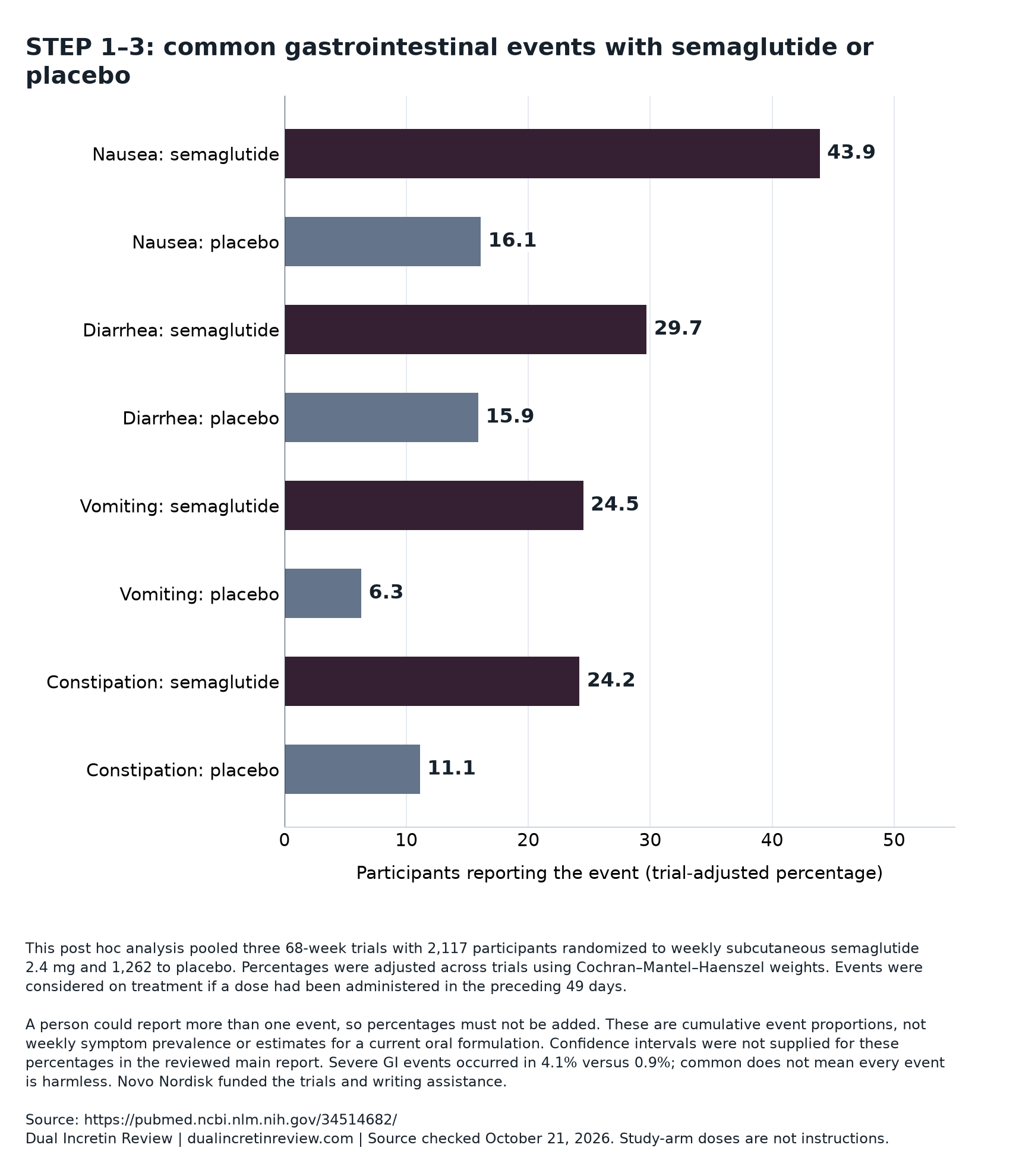
STEP 1–3: common gastrointestinal events with semaglutide or placebo
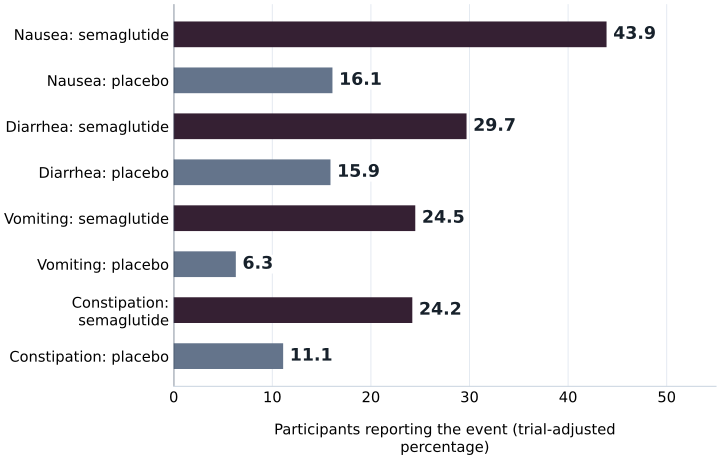
This post hoc analysis pooled three 68-week trials with 2,117 participants randomized to weekly subcutaneous semaglutide 2.4 mg and 1,262 to placebo. Percentages were adjusted across trials using Cochran–Mantel–Haenszel weights. Events were considered on treatment if a dose had been administered in the preceding 49 days.
A person could report more than one event, so percentages must not be added. These are cumulative event proportions, not weekly symptom prevalence or estimates for a current oral formulation. Confidence intervals were not supplied for these percentages in the reviewed main report. Severe GI events occurred in 4.1% versus 0.9%; common does not mean every event is harmless. Novo Nordisk funded the trials and writing assistance.
Source 1Download the source-labeled chart (PNG) · Download the data (CSV)
| Event and randomized assignment | Reported value |
|---|---|
| Nausea: semaglutide | 43.9 |
| Nausea: placebo | 16.1 |
| Diarrhea: semaglutide | 29.7 |
| Diarrhea: placebo | 15.9 |
| Vomiting: semaglutide | 24.5 |
| Vomiting: placebo | 6.3 |
| Constipation: semaglutide | 24.2 |
| Constipation: placebo | 11.1 |
Sections in this article
Three randomized trials, one later exploratory analysis
This was not a newly conducted tolerability trial. Researchers revisited participant data from STEP 1–3, which compared once-weekly injections of semaglutide 2.4 mg with placebo for 68 weeks. Adverse-event incidence was a supportive secondary safety endpoint in the original trials; pooling the gastrointestinal findings and analyzing their relationship with weight loss were post hoc, meaning planned after the original trial framework.
The populations were related but not interchangeable. STEP 1 and STEP 3 enrolled adults without diabetes who had obesity, or overweight with a weight-related condition. STEP 2 enrolled adults with overweight or obesity and type 2 diabetes. Lifestyle support also differed: STEP 3 used intensive behavioral therapy, while STEP 1 and STEP 2 used lifestyle intervention. These differences matter when interpreting a combined average.
The evidence here includes the full primary analysis and its main participant-disposition table, not an independent review of every original protocol or supplementary file. Novo Nordisk funded the trials and editorial assistance; three authors were company employees and shareholders. These disclosures help readers evaluate the analysis alongside its methods. The guide to who participated in an incretin trial explains why eligibility belongs beside every headline result.
Source 1Reading symptom frequency without double-counting people
Gastrointestinal adverse events were more frequent with semaglutide, but they were also common with placebo. The adjusted proportions with any gastrointestinal event were 72.9% and 47.1%, respectively—a difference of 25.8 percentage points. That is an absolute difference in reported occurrence, not a hazard ratio or a statement about how much longer symptoms lasted.
Nausea showed the largest absolute gap among the four common symptoms in the table. Subtracting the placebo percentage from the semaglutide percentage gives 27.8 percentage points for nausea, 13.8 for diarrhea, 18.2 for vomiting and 13.1 for constipation. These describe differences within the pooled trial analysis, not predictions for an individual.
The rows must not be added together: one participant could experience nausea, vomiting and constipation. The percentages were also adjusted across trials using statistical weights. Consequently, dividing the raw participant counts in the disposition table does not reproduce the adjusted overall rates. The weighted estimates and the raw counts answer related but different summaries of the data.
| Reported event | Semaglutide 2.4 mg | Placebo |
|---|---|---|
| Nausea | 43.9% | 16.1% |
| Diarrhea | 29.7% | 15.9% |
| Vomiting | 24.5% | 6.3% |
| Constipation | 24.2% | 11.1% |
| Any gastrointestinal event | 72.9% | 47.1% |
Event severity is not the same as a person’s experience
Two reassuring-looking figures require particular care: 99.5% of gastrointestinal events with semaglutide were nonserious, and 98.1% were mild or moderate. Those denominators are events, not participants. They do not mean that 99.5% of people were unaffected, or that every participant experienced only mild symptoms. Someone could report several mild events and one severe event.
Severity and seriousness are also distinct classifications. Severity concerns intensity; seriousness is a regulatory classification tied to outcomes such as hospitalization or other major consequences. The analysis separately reported severe gastrointestinal events in 4.1% of semaglutide participants versus 0.9% of placebo participants, an absolute difference of 3.2 percentage points.
Symptoms were elicited through open-ended, nonleading questions and followed at subsequent contacts. That approach captures reported experiences but is not equivalent to a daily standardized symptom diary. An adverse event is an occurrence recorded during study observation; its recording alone does not prove the drug caused that particular episode. The randomized placebo comparison strengthens interpretation of the overall excess.
Source 1Early clustering did not mean symptoms disappeared after escalation
The trial regimen increased semaglutide gradually over an initial 16-week escalation period. Gastrointestinal events occurred most often during or shortly after those increases. The cumulative proportion experiencing a first gastrointestinal event began to level off after about week 20. This describes when people first entered the symptom group, not when every symptom ended.
A useful distinction is incidence versus prevalence. Incidence here asks whether a participant experienced an event during follow-up; prevalence asks how many participants had a symptom at a particular time. Nausea, diarrhea and vomiting prevalence peaked around week 20 and then declined, while remaining higher with semaglutide than placebo throughout treatment.
A plateau in first events can coexist with repeated episodes among people who already reported symptoms. It therefore does not establish a symptom-free maintenance period or a fixed deadline for recovery. The historic escalation schedule identifies the research exposure, not an individualized dosing plan. Likewise, the study-duration guide helps distinguish a 68-week observation window from expectations over indefinite treatment.
Source 1Constipation followed a different timeline
Individual semaglutide events had estimated median durations of eight days for nausea, three days for diarrhea and two days for vomiting. Constipation was notably longer: 47 days with semaglutide versus 35 days with placebo. The researchers estimated these durations using a time-to-event method that accommodates episodes whose resolution was not fully observed.
A median is a midpoint of the estimated duration distribution, not a maximum or a guarantee. These numbers concern individual recorded events, not necessarily the total number of symptomatic days a person accumulated over 68 weeks. Recurrent short episodes can create a different burden from one isolated episode of the same median duration.
Calling every digestive effect brief would therefore erase a meaningful finding. Conversely, the 47-day estimate is not a recommendation to wait that long before seeking assessment. Duration statistics cannot distinguish ordinary constipation from severe constipation, obstruction or another illness in a particular person. The analysis measured reported events; it did not validate a home-management threshold or test a constipation treatment.
Source 1 Source 2Treatment interruption, treatment cessation and research follow-up diverged
Gastrointestinal events prompted dose reduction or temporary interruption in 12.5% of semaglutide participants versus 1.7% with placebo. Permanent treatment discontinuation specifically because of gastrointestinal events occurred in 4.3% versus 0.7%, mostly during escalation. These findings show that common symptoms did not always end treatment, but sometimes required changes within the monitored trial.
The 4.3% figure should not be substituted for all-cause stopping. In the main disposition table, 16.0% of semaglutide participants permanently discontinued treatment for any reason, compared with 19.1% receiving placebo. Participants could stop the medication yet remain in research follow-up: 94.8% of the semaglutide group were still in the trial at week 68, while 84.0% were on treatment.
Interpretation: a service’s follow-up arrangements and its contract are separate questions from a drug’s trial tolerability. Readers checking documentary terms can consult the Ro review or WeightWatchers Clinic review. Neither link establishes availability of the studied intervention, condition-specific care or trial-like outcomes. The STEP analysis itself did not compare providers or measure service performance.
Source 1Weight loss occurred without reported gastrointestinal events
The descriptive weight analysis examined participants still on treatment who had a weight measurement at week 68. In STEP 1, mean weight change was −17.3% among semaglutide participants with gastrointestinal events and −15.7% among those without them. Corresponding figures were −11.4% versus −9.6% in STEP 2, and −17.7% versus −17.1% in STEP 3.
The consistent observation is substantial weight reduction in both symptom groups—not identical outcomes or proven equivalence. Treatment assignment was randomized, but nausea and other symptoms were not. Participants who developed symptoms could differ from those who did not in ways that also influenced weight change. Excluding people who stopped treatment before week 68 adds selection toward those who remained.
The analysis also used different exposure windows: adverse events counted as on treatment if a dose had been given within the previous 49 days, whereas the descriptive weight analysis used a two-week window. These operational definitions matter when connecting events to outcomes. The observed placebo-corrected differences—14.4, 7.6 and 12.7 percentage points across STEP 1–3—are not substitutes for the original trials’ primary treatment-policy estimates.
Source 1What the mediation model actually estimated
Mediation analysis attempts to divide a treatment effect into a pathway through a measured intermediate event and pathways not through that event. Here, gastrointestinal adverse events were the proposed intermediate. A natural-effects model with imputation-based estimation attributed less than 1 percentage point of semaglutide’s additional weight reduction versus placebo to gastrointestinal events, whether defined broadly or as nausea, diarrhea and vomiting.
The unit is essential. Less than 1 percentage point of body-weight change is not the same as less than 1% of the treatment effect. For illustration only, a modeled 0.5-percentage-point contribution within a 10-percentage-point treatment difference would represent 5% of that difference. Those illustrative values are not trial estimates; they show why changing the denominator changes the meaning.
The model assumes that relevant confounding between symptoms and weight outcomes has been adequately addressed, an uncertain assumption for events occurring after randomization. Symptom timing was not fully incorporated. The report identifies 95% Wald confidence intervals in its mediation figure, but numerical bounds are not available in the accessible text used here and are not reconstructed. The model supports a small estimated contribution; it does not prove a receptor-specific biological mechanism.
Source 1Selected maintenance participants and a separate dual-receptor comparison
STEP 4 addressed a different question. Of 902 people entering a 20-week open-label semaglutide run-in, 803 who tolerated the target dose were randomized to continue semaglutide or switch to placebo. During run-in, 71.4% reported gastrointestinal events and 44 participants stopped treatment because of them. Later tolerability therefore describes a selected maintenance population, not everyone starting therapy.
Among those randomized, new-onset gastrointestinal events occurred in 41.9% continuing semaglutide versus 26.1% switching to placebo. Symptoms therefore remained possible even after participants had qualified for maintenance treatment. These percentages are not starting-treatment risks. The related SURMOUNT digestive-symptom analysis found substantial tirzepatide weight reduction with and without reported symptoms, but it was a separate post hoc investigation, not a head-to-head comparison.
Semaglutide activates the GLP-1 receptor; tirzepatide activates both GIP and GLP-1 receptors. As the dual-incretin explainer emphasizes, drug identity does not establish which receptor caused an observed clinical pattern. The two analyses used different symptom definitions and mediation units. Their findings cannot rank tolerability or isolate a GIP-specific effect. Eli Lilly funded the tirzepatide analysis.
| Evidence frame | Population and follow-up | Interpretive boundary |
|---|---|---|
| STEP 1–3 pooled analysis | 2,117 semaglutide and 1,262 placebo participants; 68 weeks | Weighted gastrointestinal incidence; exploratory symptom–weight analyses |
| STEP 4 withdrawal analysis | 803 randomized after tolerating a 20-week semaglutide run-in; trial ended at week 68 | Maintenance findings exclude those unable to qualify for randomization |
| SURMOUNT 1–4 post hoc analysis | Separate tirzepatide trials; endpoints at week 72 or total week 88 | Mediation in SURMOUNT 1–3 only; up to 3.1% of total weight-reduction effect, not 3.1 body-weight percentage points |
Current safety information sets boundaries around the trial averages
Current Wegovy and Zepbound labeling states that both drugs delay gastric emptying and are not recommended in severe gastroparesis. Their warnings include severe gastrointestinal reactions, pancreatitis, gallbladder disease and kidney injury associated with dehydration. Persistent or severe abdominal pain, with or without vomiting, warrants prompt clinical assessment rather than reassurance based on average trial duration.
Both labels list postmarketing reports of ileus, intestinal obstruction and severe constipation, including fecal impaction. Voluntary reporting cannot reliably establish incidence or causality. Rare aspiration reports during anesthesia or deep sedation also appear; the labels advise informing procedural teams and acknowledge insufficient evidence to determine a withholding schedule. These warnings do not identify the mechanism behind every nausea episode.
The STEP analysis tested injected semaglutide, not oral semaglutide, compounded preparations or supplements. The ingredient, brand and preparation guide explains why those distinctions matter. Neither the STEP nor SURMOUNT symptom analysis randomized participants to probiotics, fiber or other symptom remedies. Their results cannot demonstrate supplement prevention, improved adherence or a dietary treatment effect.
Source 1 Source 3 Source 2 Source 4Questions about the evidence
Does having no nausea mean semaglutide is not working?
No. Participants without reported gastrointestinal events still had substantial mean weight reduction in all three STEP trials. That observation argues against using nausea as a necessary sign of effectiveness. It does not predict an individual response, and the symptom groups were not randomized. Weight outcomes and tolerability need to be assessed separately.
Source 1Why was the placebo gastrointestinal event rate so high?
The analysis found a 47.1% adjusted rate with placebo, showing that digestive symptoms also occurred without semaglutide exposure. It did not establish a single explanation for that background burden. Population characteristics, other illnesses and trial circumstances may matter, but their separate contributions were not quantified. The placebo arm provides the relevant comparison rather than a zero-symptom baseline.
Source 1Does the 47-day constipation median describe everyone’s experience?
No. It is an estimated median duration of individual constipation events, not a universal duration, a maximum or a recommended waiting period. Some episodes were shorter and others longer. It also does not distinguish benign constipation from a potentially serious cause of persistent symptoms; current labeling includes severe constipation and obstruction reports.
Source 1 Source 2Do these studies show that tirzepatide is easier on the stomach?
No. These analyses were not a randomized comparison of tirzepatide against semaglutide. They differed in populations, trial designs, symptom definitions and analysis sets. Broad ranges across SURMOUNT arms cannot be compared with a weighted STEP percentage as though participants had been assigned between the two drugs under otherwise identical conditions.
Source 1 Source 3What research would clarify the symptom–weight relationship?
Prospective studies with repeated standardized symptom measures could better connect symptom timing, severity, food intake and weight change. Analyses that retain follow-up after treatment cessation would clarify selection effects. Randomized trials of specific symptom-management approaches would be needed to establish whether they reduce symptoms or improve persistence; merely observing their use does not establish benefit.
Source 1 Source 3Editorial assessment
The strongest conclusion is that gastrointestinal adverse events were common with injected semaglutide but were not necessary for substantial observed weight loss. The placebo comparison establishes an excess of reported symptoms, while the duration and discontinuation findings describe a burden that varied considerably across events and participants. The mediation analysis adds evidence for a small symptom-linked contribution, but its exploratory assumptions prevent a definitive causal explanation. For Dual Incretin Review, the central distinction is between pharmacologic identity and demonstrated mechanism: neither similar symptom patterns nor similar mediation conclusions reveal the separate contribution of each receptor.
Research access and limitations
This article uses the full primary STEP and SURMOUNT post hoc reports and targeted official prescribing-information sections. Supplementary files and original trial protocols were not independently reviewed. Numerical confidence-interval bounds not available in the accessible text were not inferred from figures. Findings concern the studied formulations, populations and follow-up periods.
Follow the evidence
Scientific sources checked October 21, 2026. Earlier research and provider sources retain their dated histories below. Scientific articles identify the original reports and labeling examined, with access limits stated in each article. Provider pages document advertised offers.
- Gastrointestinal tolerability of once-weekly semaglutide 2.4 mg in adults with overweight or obesity, and the relationship between gastrointestinal adverse events and weight loss.Full primary post hoc analysis main text and main Table 1 reviewed; supplementary file and original trial protocols not independently reviewed. · Checked 2026-10-21
- DailyMed: WEGOVY semaglutide current prescribing informationCurrent official DailyMed label, updated June 18, 2026, current archive June 30, 2026; indications, relevant safety sections 5.2, 5.3, 5.5, 5.6, 5.10, postmarketing experience and oral-drug interaction sections reviewed. Other sections not fully reviewed. · Checked 2026-10-21
- Gastrointestinal tolerability and weight reduction associated with tirzepatide in adults with obesity or overweight with and without type 2 diabetes in the SURMOUNT-1 to -4 trials.Full primary post hoc report, Methods, Results, main Table 1 and Discussion/funding reviewed; supplementary tables and source-trial protocols not separately reviewed. · Checked 2026-10-21
- DailyMed: ZEPBOUND tirzepatide current prescribing informationCurrent official DailyMed label, updated August 28, 2026, current archive September 2, 2026; indications, relevant safety sections 5.2 through 5.5 and 5.9, postmarketing experience and oral-drug interaction sections reviewed. Other sections not fully reviewed. · Checked 2026-10-21